Category Archives: Home Accessories

Design Diary: Frank Roop in Nantucket (Part II)

If you read my last post, you know that Sunday’s edition of the Boston Globe Magazine featured “Living Brilliantly”, the piece I wrote about a Nantucket house with interiors by Frank Roop .I know I promised Part II of this dreamy spot yesterday, but life (well, kids home on summer vacation) got in the way. Three doctor’s appointments, a teacher conference, a trip to the playground, two playdates, a four hour hair appointment (hey, straight hair takes time) and a massive Target trip later, here’s the other half!

Photography by Eric Roth – Courtesy of The Boston Globe
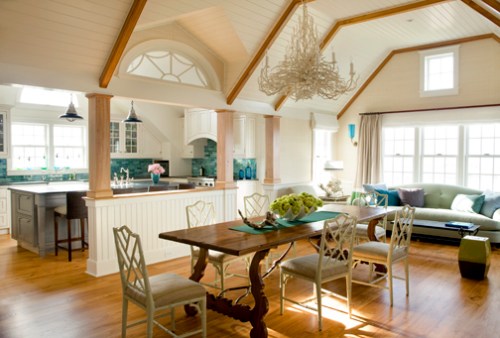
1 Globe Frank Roop Great Roomthe dining room

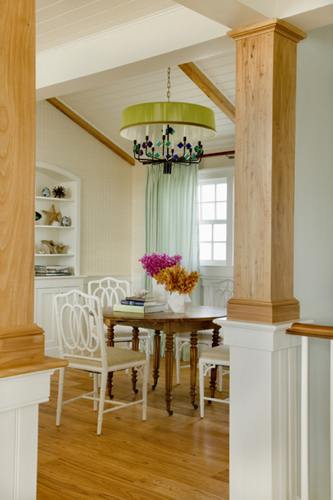
Don’t you love the chandelier? It’s a very heavy commercial piece, probably from a restaurant, from the 1960s. It resembles of mass of tangled twigs, or maybe coral. Roop calls its look “a nod to the ocean without being corny.” The antique table came from a Paris flea market. The homeowners bought it on a trip years ago, and had been storing until they had the space for it. Roop added the vintage faux bamboo chairs that he had lacquered in celery green (I know, they look white here) and reupholstered. Roop filled a huge clamshell he found in the basement with hydrangea for the shoot.

– – –
2 Globe Frank Roop Kitchenthe kitchen

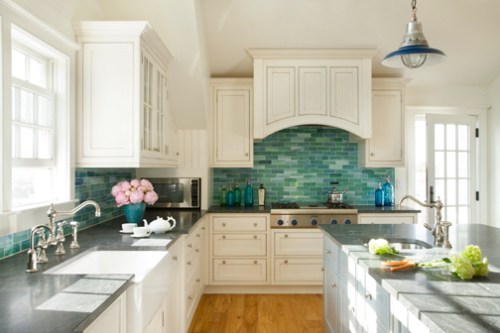
The perfect kitchen. The sea colored glass tiles are divine. Roop ordered them in an array of custom color arrangement from Ann Sacks. They make a perfect backdrop for the wife’s collection of green and blue seltzer bottles, which she’d been collecting over the years and acquired mostly in Paris and at Brimfield. She says, “I have a bunch of them; some have old wicker around them. They’re antique and very heavy. I love them; I have been hoarding them for Nantucket.”

The cabinetry is from Dalia Kitchen Design in the Boston Design Center. You can’t tell here, but the base of the island is stained a light blue color to break it up and bring in more color. The cooktop is Thermidor, with cobalt blue knobs, similar in color to the vintage Greek fisherman pendants that were acquired by Roop through a dealer. The countertop is jet mist honed granite from Gerrity Stone in Woburn, Mass. (a popular source around here). They wanted a honed stone because they felt is was less formal than a polished stone, and it also created a soapstone look without the fragility. (Soapstone is pourous and stains easily.

– – –
3 Globe Frank Roop Sitting Room off DRsitting room off the dining room

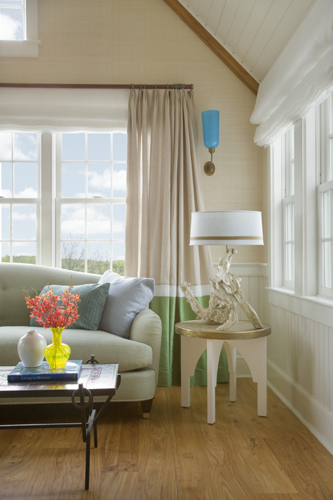
This is the room you see in the background in the dining room shot above. How great is that 1950s driftwood lamp? Of course, Roop added a new shade, white linen, I think, trimmed in khaki grosgrain ribbon. Even better are teh 1820s blue opaline glass sconces from England. Love, love, love. Roop designed the side table, using a Moorish shaped-base to continue the exotic accents theme. The top is bronze, with a Moroccan pattern stamped on it. The coffee table is by French Modernist Jacques Adnet. It has a tile top in its iron base. (You can find some similar pieces by Jacques Adnet on 1st Dibs.) And, by now you’ll recognize Roop’s signature drapes. These are made from green silk that looks like linen (imported from Thailand), white linen and khaki linen. I’m thinking of trying this look in my Back Bay bay living room bay windows.

– – –
6 Globe Frank Roop LRthe living room

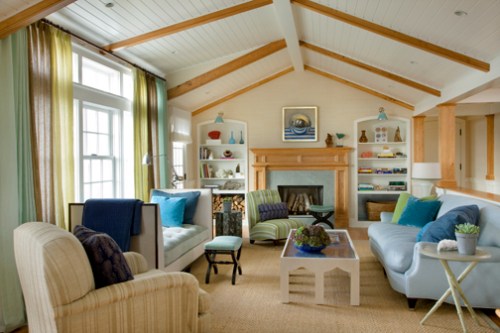
Let’s start with the rug. Like pretty much everywhere else in the house, the living room rug is sisal. The family has two dogs (a chocolate lab and a mutt) and three cats, so they needed a pet friendly solution. The husband wanted Oriental rugs. The wife said no way. She had some rag rugs. Roop was less than charmed. So the sisal was a practical compromise. (The husband got an Oriental in his office.)

The fireplace surround is Costa Esmerelda, which is a pale green granite from Brazil. Roop designed the niche bookcases, above which are mounted sconces with sky blue pleated silk shades. Roop designed the coffee table. The open detail Moorish shape was inspired by a Robsjohn Gibbons stool he has. The top is inlaid paoa shell imported from Hawaii, which is a super shiny and lustrous veneer that Roop uses whenever he can. He has a star-shaped table covered in it in his design studio, and when the wife saw it, she insisted on his designing a piece using paoa shell for the Nantucket house. The finish is unique and gorgeous. The side table in the foreground is vintage faux bamboo. Roop designed the X-stools as well; they’re covered in a green silk canvas by Jim Thompson. The drapes are custom, but this time vertical panels are stitched together rather than horizontal swathes of color. They’re linen, with some shine, in three different colors.

Roop also designed all the upholstered pieces. (The sofa and chair were actually prototypes.) Roop uses McLaughlin Upholstering Company in Everett, Mass. to make them. The sofa fabric is a very heavy grayish blue linen, and the chairs are in a linen awning stripe. The daybed is upholstered in linen too, with a linen velvet cushion in a bluish green. Roop loves to do a contrasting cushion on a daybed, so it almost looks like a mattress. He cleverly used a daybed in front of the window because a sofa with a back would have blocked the view. The husband wasn’t crazy about the idea of seating sans back, but it’s the wife’s favorite seat in the house. She says,  “I love to sit there with a cup of tea and look out at the sky with the sun shining in on me; I can see the water in the distance, I love that seat, it is my favorite place.”

– – –
4 Globe Frank Roop Game Roomthe game room

This is a little room off the living room where the family does puzzles. Their old house did not have a television, so they did a lot of puzzles, and wanted to be sure to fit in a dedicated round table for puzzles here. The table was found by the homeowners in a Paris flea market. The chandelier is thoroughly amazing. It’s funky Danish piece from the ’60s that Roop got from a dealer in New York City. It’s iron, embellished with handmade glass tiles. The wife adored it immediately, but both she and Roop were certain that neither the architect or her husband would like it. Surprise! They both loved it. Roop designed the chartreuse shade, which is made out of at least 100 yards of cotton cording, and trimmed in suede around the bottom edge.
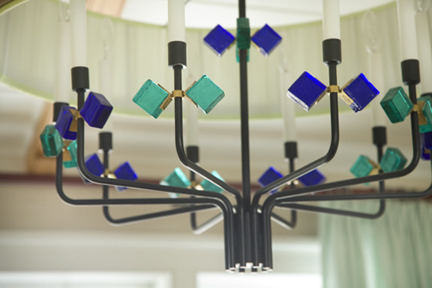
5 Globe Frank Roop Game Rm Chandelier

[tweetmeme source=”StyleCarrot” only_single=false]
2 Comments

Filed under . REGULAR FEATURES, Design Diary, Furniture, Home Accessories, Rooms

Design Diary: Frank Roop in Nantucket (Part I)

This week’s edition of the Boston Globe Sunday Magazine featured “Living Brilliantly”, the piece I wrote about an absolutely beautiful Nantucket house with interiors by Boston über-star designer Frank Roop.

Roop designs much of the furniture he uses, as well as the draperies and lampshades. And, he uses local artisans to do it. Roop explains, “For me, it’s not about going to design center showrooms. I’d rather support local craftsmen. I think I am one of the few designers that stick to that principle of design.” If Roop hasn’t designed it, chances are the piece is vintage or antique. He hardly ever buys anything new. Eco-conscious and chic.

I’ve split this story into two parts. Today you’ll see the first floor rooms; tomorrow, the upstairs.

Photography by Eric Roth – Courtesy of The Boston Globe


exterior roop

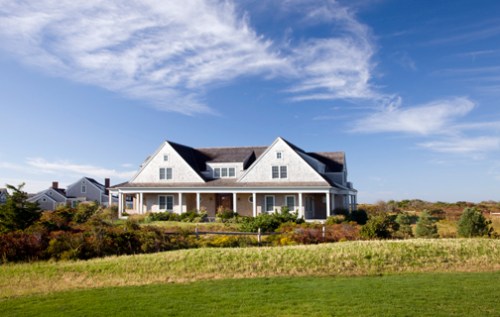
The neoclassic Shingle Style house, located on two acres in the Cisco area of the Island, is owned by a Newton couple with three daughters, ages 18 to 23. It’s 5,000 square feet, with an upside down layout (the bedrooms are on the first floor and the living spaces on the second, to take advantage of the water views). Previously, the family spent their summers in a more cottage-y sort of place that they had purchased about nine years ago, with plans to renovate. But when they were able to buy a little more land next door that had a better view, they decided to commission local architect Nathan McMullen of McMullen and Associates to design a brand new dwelling. (It was built by Kris Perez’s Falkon Building Co.)

Instead of calling in the bulldozers to demolish their old house, they gave it away. The wife told me in a telephone conversation, “Guys came, cut it in half, moved it to the new site around the corner, and put it back together.” Apparently Nantucket requires that you try to do that before tearing down a house. It’s actually a less expensive alternative to demolition, and, more importantly, it helps keep rubbish out of overcrowded landfills. While this family arranged the transfer directly with their neighbor, real estate can also be donated to organizations like Housing Nantucket, which provides affordable housing solutions on the Island.

As for the interior, the homeowners wanted the decor to work with the somewhat formal architecture, but still have it feel like their at the beach. Comfortable, but not too casual. Take the tour; I think you’ll agree that Roop’s approach was a success.

Globe Roop Nantucket Entrywaythe entry

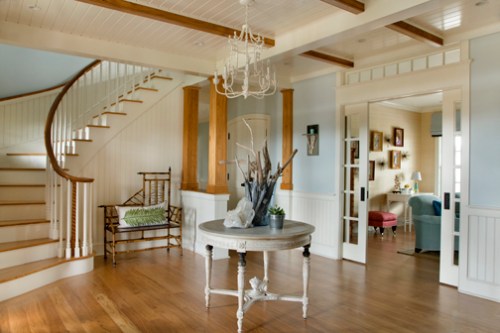
The airy entryway, complete with swooping staircase, is anchored by a painted, Swedish neoclassical table, above which hangs a faux bamboo chandelier Roop found in Upstate New York. A tableau of earthy items, both ordinary (pieces of driftwood in a glass vase) and a little glam (a hunk of quartz from Brazil) are arranged on the table with a small succulent. The asymmetrical bamboo bench dates from the Aesthetic Movement of 19th century England. It’s real bamboo, and the husband is less than fond of it. Roop acquired it from an antiques dealer in Connecticut. (Nope, he won’t reveal his sources, I tried!)

Notice the sconce to the left of the pocket door . . . Roop made them as a housewarming surprise for the owners. They’re made from natural coral that’s been lacquered and Tahitian mother of pearl. When the votives are lit, the candlelight reflects off the mother of pearl gorgeously. I wish I had a closeup shot; we can’t see them very well here.

As you can see, the architectural details are pretty traditional, with a plank wood floor, exposed, unpainted beams, and wainscotting halfway up the walls and on the ceiling. The wife told me that they agonized over whether to leave the beams au naturel or to paint them. Her husband won that one. he says, “Guys are all about wood but it looks structural, and good.” She appreciates that it provides some warmth to the cool color palette. The flooring, as well as the posts and beams are Chinese elm reclaimed from palaces in China.

– – –

Globe Roop Side Table Vignette niche off the entry

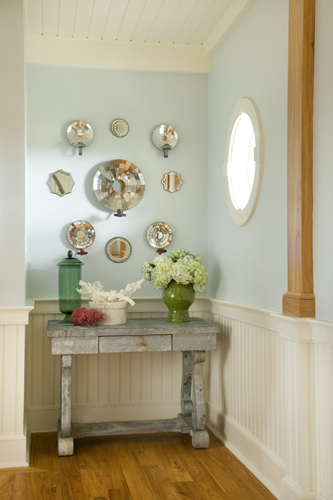
If you look at the entry photo again, you’ll see a little niche cordoned off by the posts. That niche is what you’re seeing in this shot. The distressed console table is sheathed in old, patinated zinc sheet metal. The green glass jar is vintage Venetian, the white container with the coral branches on it is a matte ceramic pottery mold, and the pot filled with hydrangeas is 1960s vintage. The bull’s eye design is comprised of colonial mirror-back sconces that would have held candles mixed with small mirrors, all found at various antique shops. The shape echoes the round window off to the right, which is actually the house’s only round window.

– – –

Globe Frank Roop Office Vignettethe family room

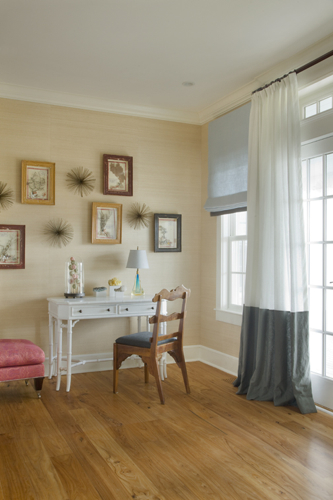
You can see this half of the family room through the glass pocket doors in the entry. Paired with the white faux bamboo desk is what Roop called a “California chair with free from wood” from the a 1970s. On the wall are framed vintage shell collages done with old paper and calligraphy that the wife found in a Paris flea market. Roop added the anemone wall sculptures to the mix. The drapes are in Roop’s signature style, from multiple fabrics stitched together.

– – –

7 Globe Frank Roop girls bedroomyoungest daughter’s bedroom

The homeowners wanted their daughters’ rooms to be reflect their individual personalities, so they were allowed to choose their colors “to a certain degree,” says the mom.

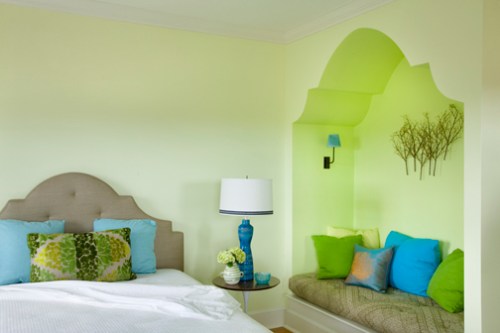
The youngest wanted a lime green bedroom so Roop found a pale shade that the daughter liked and that the mother could live with, and using a more acid bright in the niche. Roop came up with the idea to carve out a reading niche to make use of the dead space in the room. The Moorish shape echoes the silhouette of the custom designed, linen-covered headboard, and adds an ethnic note that’s found throughout the house. The niche cushion is a woven Donghia fabric with a Moroccan pattern and the 1960s metal branch sculpture above is by Jere. The green pillows on the bed are made from a burnout velvet gofrage linen. And, yes, that’s a vintage Saarinen table with a rosewood top. On top sits a 1960s studio pottery lamp with a custom shade white linen shade trimmed with grosgrain ribbon, a Roop signature touch.

The middle daughter’s room is done in corals, with white walls and a headboard and pillows made from orange silk that they brought back from Cambodia, to which Roop added a Moroccan wedding blanket embellished with tiny mirrors. Roop had other items from the couple’s travels framed for the room, including a child’s dress from India, camel decorations, and a pony bridle.

The eldest daugher’s room has ice blue walls, a bright teal cut velvet chaise, and a vintage surfing poster her mom bought at Brimfield years ago, as well as a photograph of her diving with dolphins on her 21st birthday during a family vacation.

8 Globe Frank Roop Master Bedroommaster bedroom

I love this room, with its touches of pale and clear seaside color.

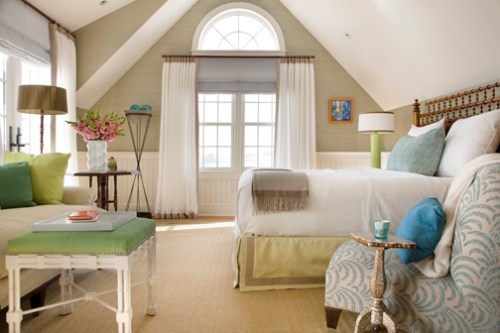
The faux bamboo bed is a piece the homeowners found a while back in Maine. The green porcelain vintage lamp on the far side of the bed looks like strops of bamboo. Roop designed the slipper chair, which is covered in an Anna French gofrage linen velvet. The antique Syrian sidetaable is inlaid with mother-of-pearl, acquired  by Roop from one of his Paris resources. He uses them a lot – they’re great for drinks and can be moved around easily.

In the back of the room stands a jardinière planter to which Roop added a concrete vessel and blue glass balls that the homeowner already had. The floor lamp is a faux bamboo Jacque Adnet piece covered in Hermes leather and finished with a custom lampshade constructed from string (another Roop specialty). The Roop-designed sofa is covered in sand-colored linen and the vintage faux bamboo stool is topped with a cushion of silk canvas. Finally, like most of the rugs throughout the house, this one is a natural, no-nonsense sisal.

9 Globe Frank Roop master bathmaster bath

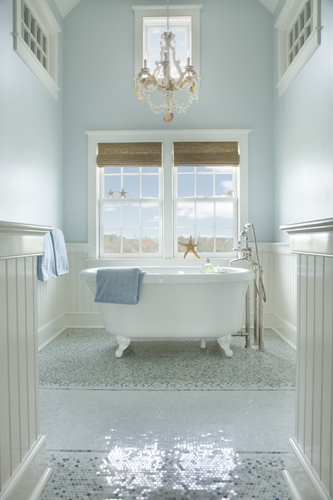
This dreamy bathroom has the only tub in the house (it’s a Bain Ultra air jet tub). The homeowners had picked out the fixtures before hiring Roop, but Roop chose the tiles and custom-designed the watery palette and pattern. The tiles, which came from Tile Showcase, are all marble and very shimmery, and were designed to look like rugs.

The homeowner chose the shell chandelier from a lighting store in Nantucket. She says this about it, “I wanted something borderline tacky; something I wouldn’t do anywhere else, like over my dining room table. It is kind of kitschy, since it’s made out of shells, but I think it’s perfect for the bathroom.”As for the rattan shades, the windows were originally bare, but they needed a little privacy, and she likes the warmth of the woody accents.

Check back tomorrow to see the upstairs living spaces!

[tweetmeme source=”StyleCarrot” only_single=false]
13 Comments

Filed under . REGULAR FEATURES, Design Diary, Home Accessories, Rooms

Shopping: 1st Dibs Saturday Sale

While the boys are out on Boston Common throwing baseballs, I thought I’d see what kind of “bargains” I could find on 1st Dibs’ Saturday Sale. Here’s what I turned up:

1st-dibs-sat-sale-may

1st Dibs Saturday Sale

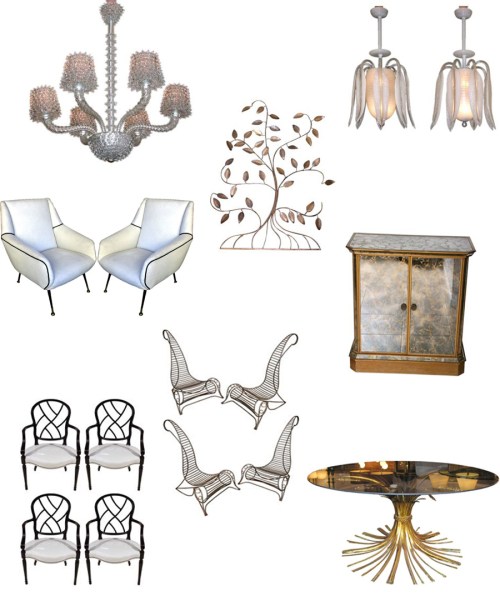
Italian Rostrato’ Chandelier from the 1940’s in the style of Barovier, $3,000, reduced from $8,250; Ed Hardy, San Francisco.

Pair of Italian Art Deco Pulegoso’ Chandeliers from the 1930’s, made of milky hand-blown bubbled glass and clear glass, $18,750, reduced from $62,500; Ed Hardy, San Francisco.

Pair of Italian Club Chairs from the 1950’s in the style of Marco Zanuso, upholstered in ultra suede, $3,800 reduced from $4,60; Adesso, Pasadena, California.

Jere Tree Sculpture from the 1970’s, signed and dated, $550, reduced from $975; Flessas Design, New York City.

Mirrored and Gilt Dry Bar from the 1960’s, $1,900, reduced from $2,900; Pierre Anthony Galleries, West Palm Beach, Florida.

Set of 4 Ebonized Dining Chairs from the 1960’s with new white faux patent leather upholstery with chrome buttoning, $2,800, reduced from $3,600; The Antique and Artisan Center, Stamford, Connecticut.

Set of Four Iron Chairs in the style of Dubreuil, 20th century, works indoors or outdoors, $9,800 reduced from $12,000; Pierre Anthony Galleries, West Palm Beach, Florida.

Italian Gilt Iron Wheat Coffee Table from the 1960’s, $950, reduced from $1,650; Mid Century Antiques, Stamford, Connecticut.

2 Comments

Filed under Furniture, Home Accessories, Shopping

Shopping Trip: Brimfield Antique Show

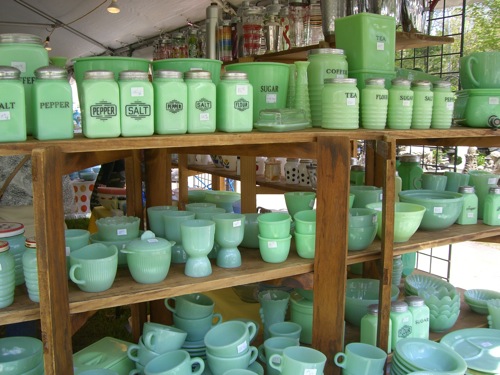
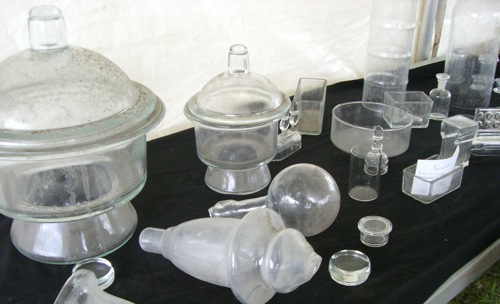
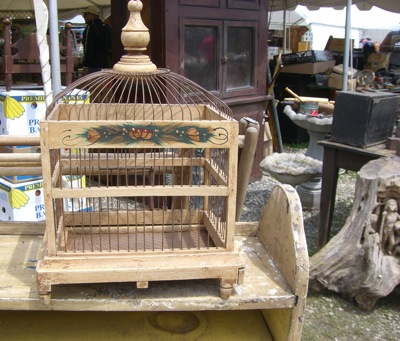
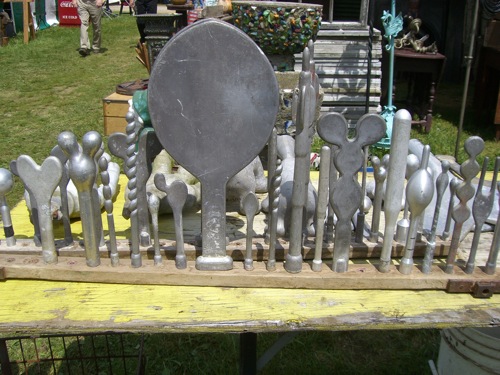
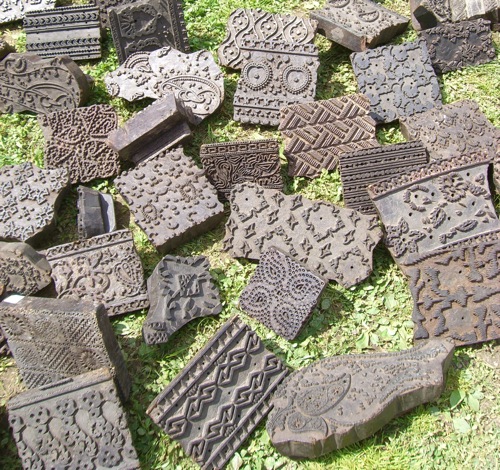
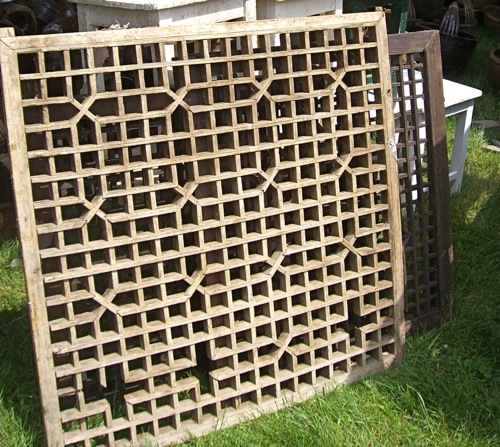
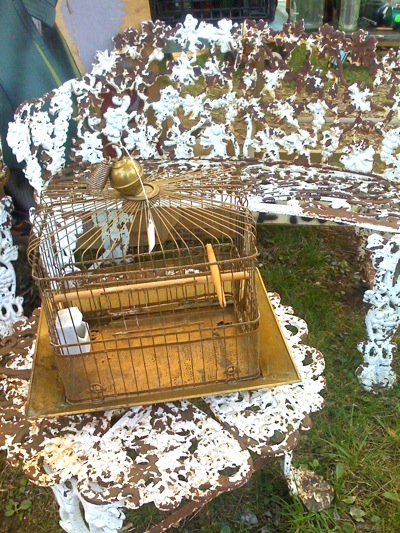
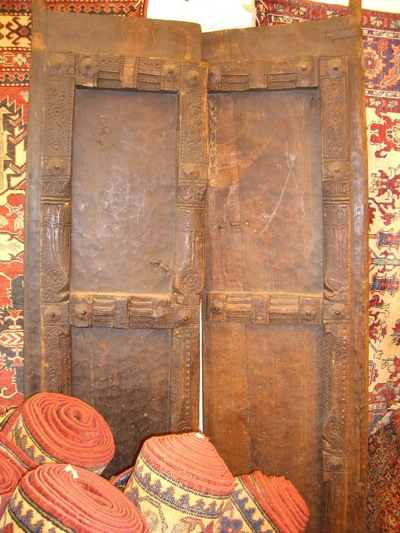
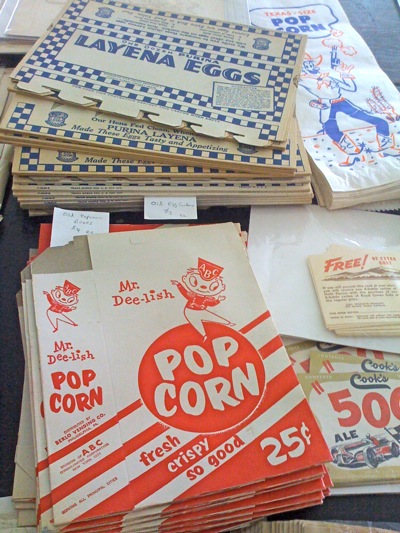
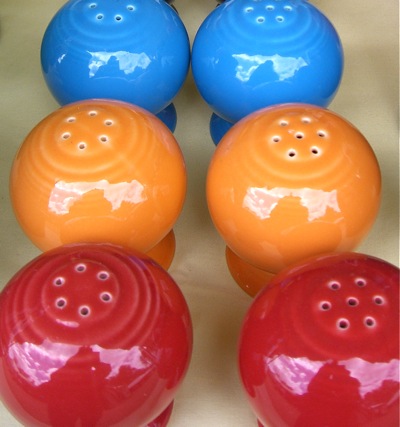
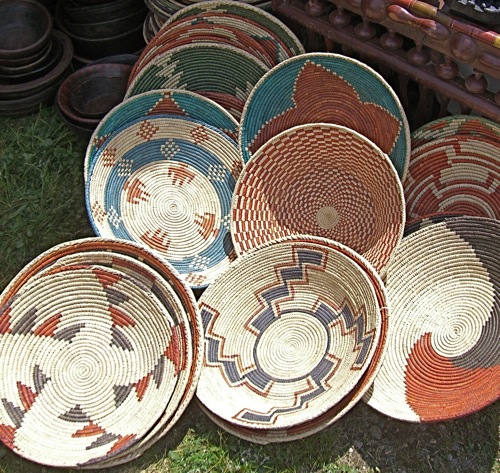
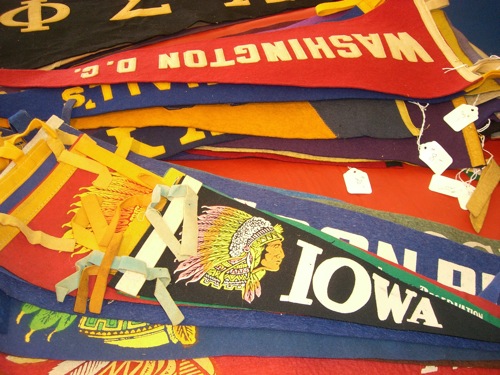
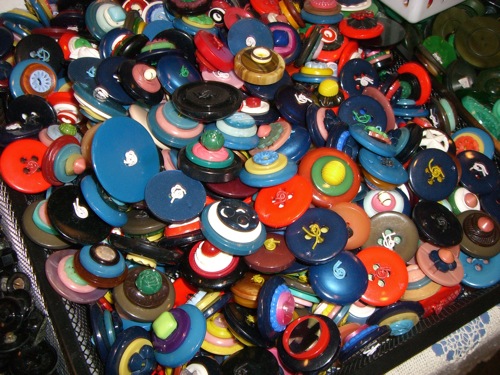
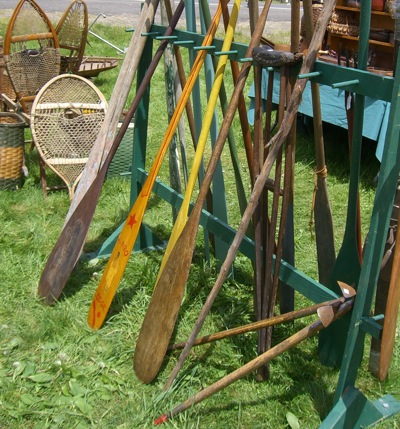
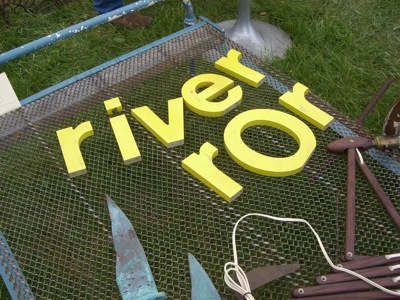
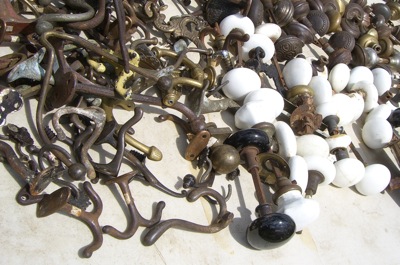
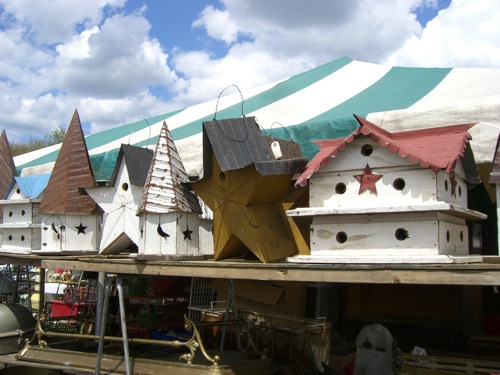
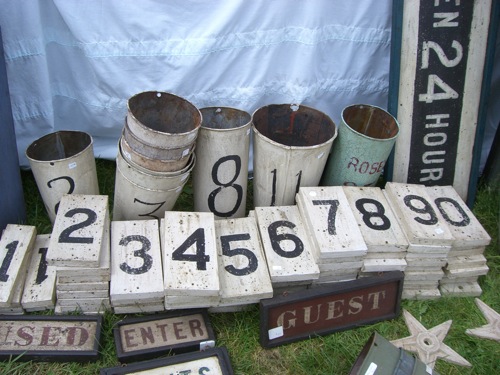
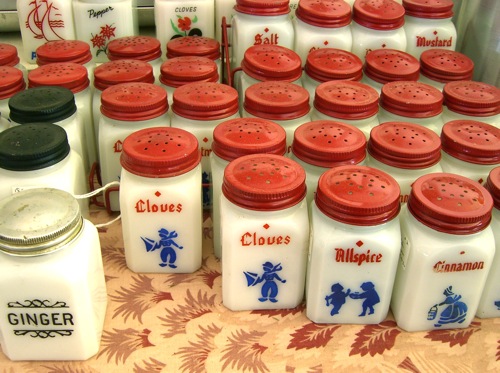
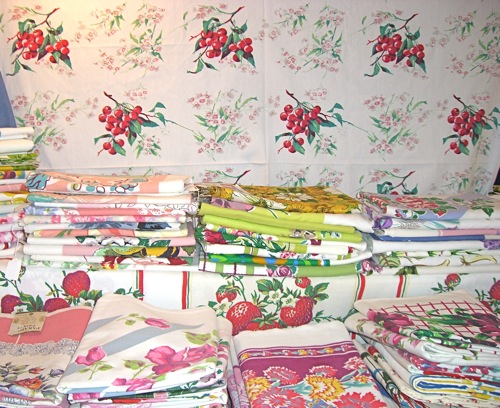
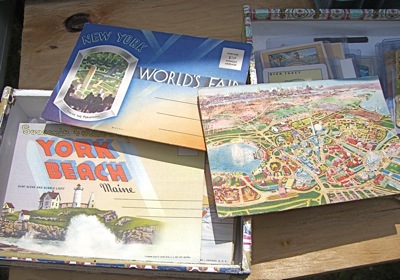
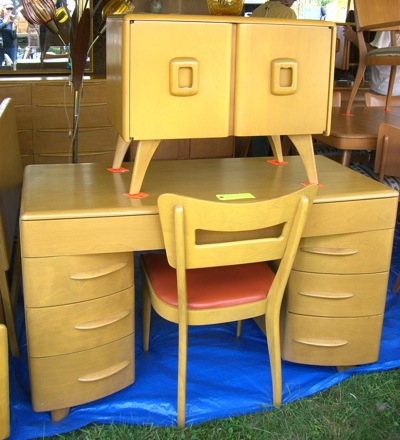
Yesterday I went to Brimfield for the first time! Luckily, I met up with Jill Goldberg with the impeccable taste from Hudson, who pointed me in the right direction. It runs to the end of the week if you have a chance to visit. (And it’s back again in July.) It was a quick 90-minute drive from Boston. Here are some things that caught my eye:
CIMG7254.JPG
CIMG7295.JPG

CIMG7280.JPG
CIMG7264.JPG

CIMG7283.JPG

CIMG7259.JPG

CIMG7272.JPG

CIMG7294.JPG

CIMG7276.JPG

CIMG7282.JPG

IMG_0837.JPG

CIMG7260.JPG

CIMG7278.JPG

IMG_0834.JPG

IMG_0802.JPG

CIMG7316.JPG copy

IMG_0835.JPG

IMG_0818.JPG

CIMG7301.JPG

IMG_0807.JPG

CIMG7285.JPG

CIMG7289.JPG

CIMG7262.JPG copy

CIMG7318.JPG

CIMG7320.JPG

CIMG7311.JPG copy

CIMG7277.JPG

CIMG7281.JPG

CIMG7274.JPG

CIMG7269.JPG

IMG_0830.JPG

IMG_0829.JPG

CIMG7271.JPG

CIMG7322.JPG

CIMG7298.JPG

CIMG7273.JPG

CIMG7268.JPG

CIMG7312.JPG

12 Comments

Filed under . REGULAR FEATURES, Furniture, Home Accessories, Shopping, Shopping Trip

Design Diary: Lydia Shire’s Kitchen Collections

pantryPhoto courtesy of Boston Globe.

Earlier this year I visited chef Lydia Shire at her home in Weston, Mass., to write a story about her kitchen, and more importantly, her overflowing collections of kitchen paraphernalia. The piece “A Cook’s Collection” was published last weekend in the Boston Globe Sunday Magazine. (If you’re not acquainted, Lydia owns the restaurants Scampo and Locke-Ober in Boston and Blue Sky in York, Maine.) She’s a colorful character, as her home attests…

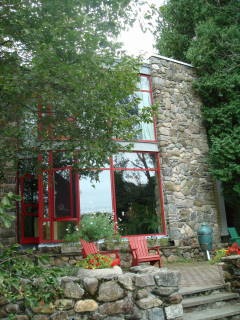
Outside, the house is a quietly pretty, traditional New England clapboard colonial/farmhouse. As you can see, it was a snowy day when I visited. Unfortunately, Lydia was dealing with some type of flooding that occurred the night before; there were all sorts of workmen there. (Hence, the Chevy pickup.)

exterior

Inside, it’s bright, cheerful, loud, decked out in an abundance of color and kitsch. The photos I shot of her living room are too blurry to post, but here’s a great one of her fantastic dining room.

dr1

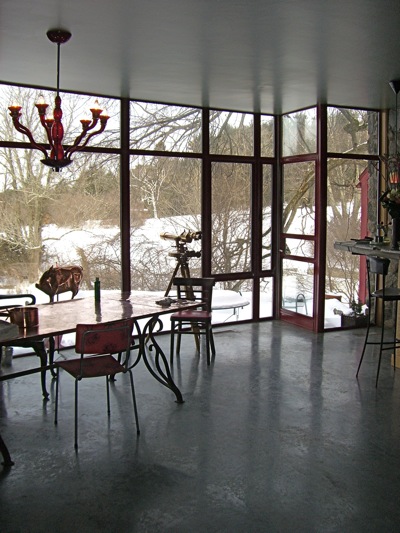
The kitchen is amazing. It’s at the back of the house. The entire back wall is glass, with red steel windows, and a door that opens to the patio and field. (The property was a farm way back.) Lydia’s daughter, Lisa Shire, designed the renovations it as her first project out of architecture school, after everyone Lydia brought to see the house told her not to buy it because it was too run down. I wish I had a better photo, but this will have to do. Just be sure to imagine that the window frames are bright red, as is the Venetian glass chandelier. The table, which she got at Brimfield, has a copper top.

table

The floor is concrete. Here’s the story Lydia told me about how it came to be:

“I saved money to do the house over. I had X dollars, and you usually go over and scramble at the end. I didn’t know what kind of floor I wanted here; the rest of the house has quarter sawn oak. I started looking at limestone and other stones, but they were all so expensive would have sent my budget reeling. I had gone to this restaurant in Seattle that had colored, poured concrete floors, so I suggested it to my contractor. We did this for $3,000. It’s poured, polished concrete, with no color, because I didn’t want it fake. It’s perfect with the fieldstone.”

Here’s a photo that her publicist, the wonderful Jo Swani of the The Moxie Agency, sent me of the patio in summer:

summer-backyard

Here’s the area of the kitchen where the cooking happens. It’s on the smaller side, considering how large the room is, but that’s the way Lydia likes it. She has this to say:

“The great thing is this kitchen could not be better. I love the small workspace. I don’t have gadgets. To me, cooking is a pan, an instrument in your hand, it’s a cutting board, your refrigerator your stove. I don’t know why people make these massive things. For what?”

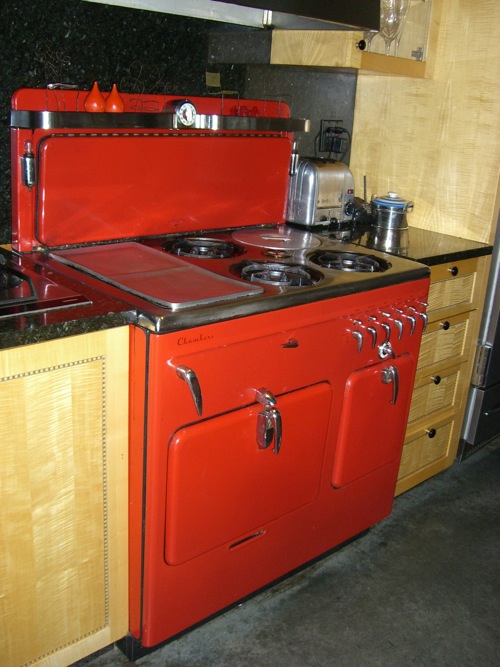
Her favorite part of the kitchen is the red stove.

red-stove

Here’s Lydia’s stove story:

“It’s Chambers; probably made in the late ’40s, maybe ’48, the year I was born. It’s America’s answer to the Aga stove, though it’s gas. My aunt had one in Newton when I was a little girl growing up. I loved it. It was an old fashioned green. I was in California in ’86; I went to Antique Stove Heaven and I saw this. It was in perfect mint condition, so I bought it for a little over $1,000 and had it shipped to Boston. My meat purveyor stored for it me. I didn’t have a house, no place to put. I finally got it out when I moved in here.”

The stove has a built-in mashed potato cooker, and a broiler that opens from the top of the stove, in which she she cooks chicken legs quite a lot. But her favorite use for the Chambers stove seems to be chocolate cake…

“It makes chocolate cake better than my Gagganeau, which is so well insulated that the heat is very uniform, so it bakes the cake slowly, whereas in this one, the heat is more intense, so the cake gets crusty on the outside and gooey inside. I always make chocolate in my old oven, progress is not always good. I could make the same cake in both ovens and you’d like the one from my red one better.”

Just a few more pics before we get to the collections…

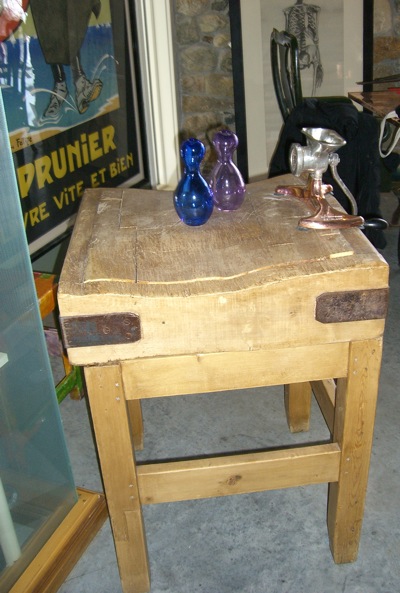
butcher-blockThis is Lydia’s butcher block. It’s old, though the stand is newish. It came from England. She says, “”I’m an incurable carnivore,” she says. “I love to think of all the happy carcasses that met their demise here.”

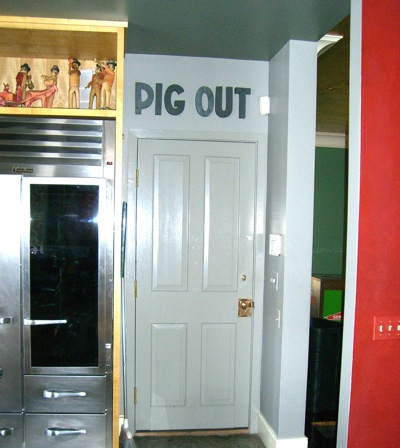
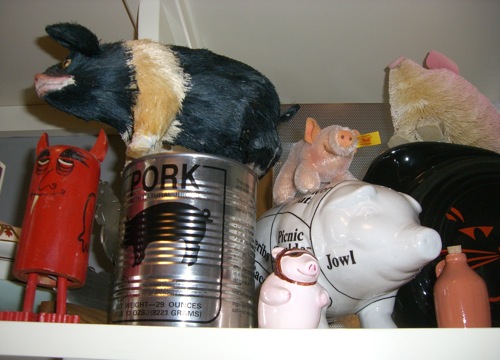
She’s especially fond of pigs.

pig-out

pigss

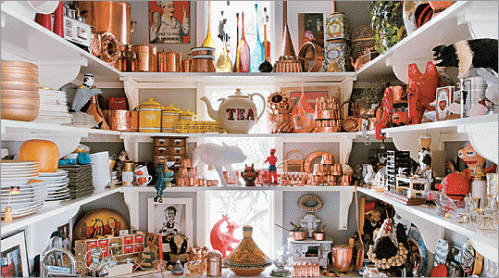
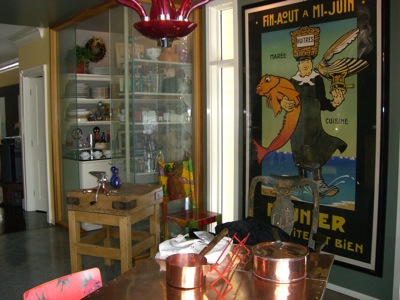
Lydia is just as much a collector as she is a chef. She says her husband calls her stuff junk, but actually most of the stuff is pretty special. She stores/displays most of the items in the pantry, a room within her kitchen with walls made from two-ply laminated glass sandwiching a layer of mesh, so they’re sheer but still provide some cover.

poster-pantry

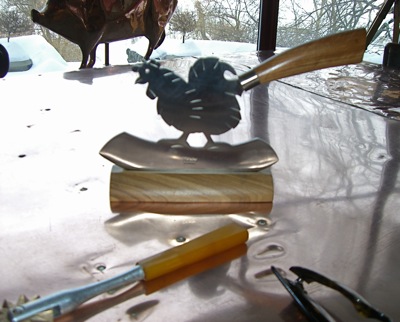
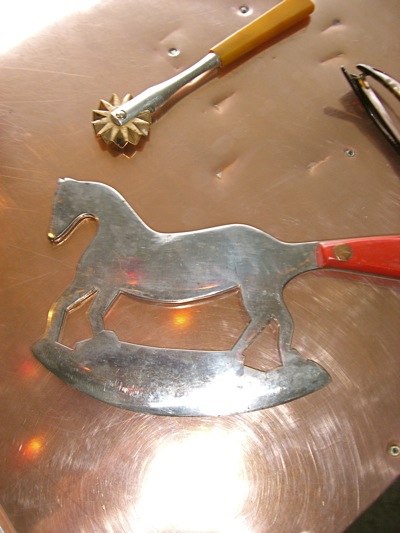
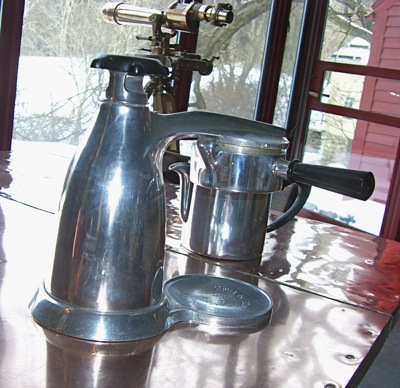
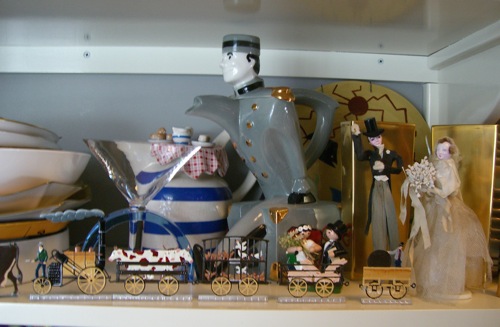
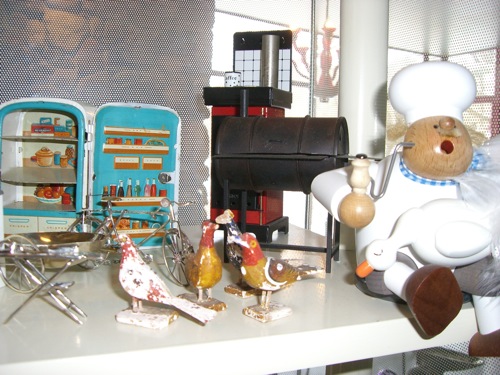
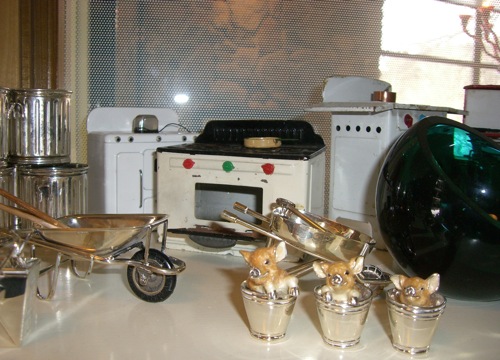
Finally, here is a sampling of her stuff!

rooster-cleaver

tools-on-copper

coffee-steamer

bride-train

chef
stove-pigs

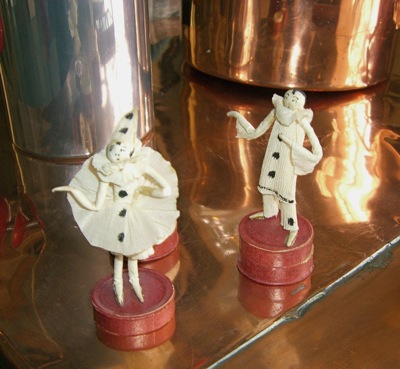
clown-candy-boxes

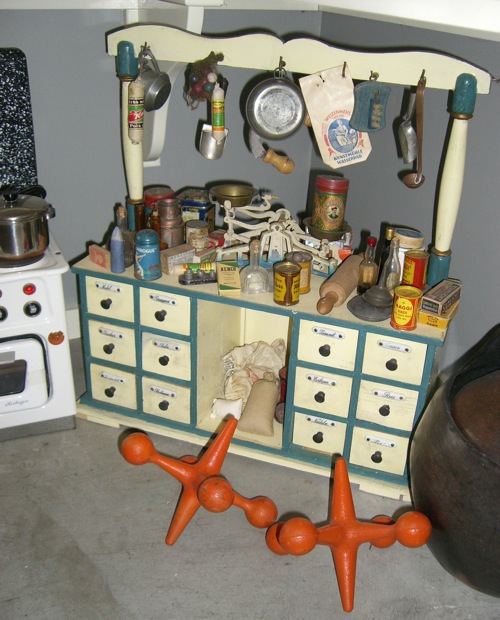
jacks
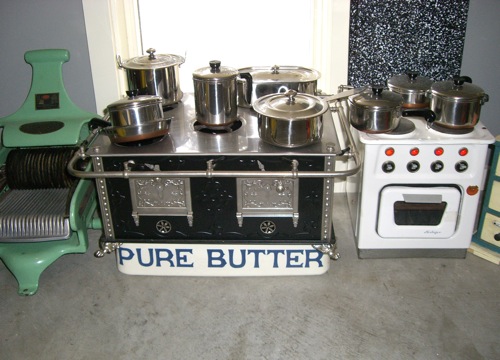
butter-stove

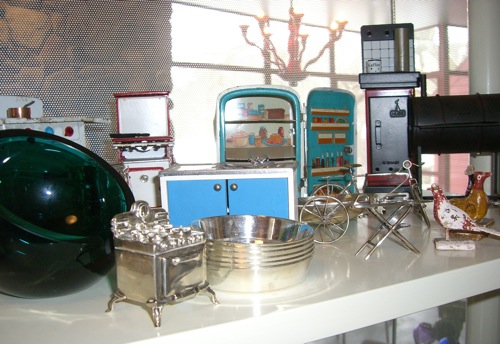
more-stoves
fowl-pl

valuable-plate

childhood

1 Comment

Filed under . REGULAR FEATURES, Design Diary, Food & Entertaining, Home Accessories, Rooms