Category Archives: Design Diary

Design Diary: Palmer Weiss Is a New Traditionalist

Finally, I present you with a San Francisco home designed by Palmer Weiss, featured in Traditional Home‘s TRADhome this month. She is one of the magazine’s 10 New Traditionalists.  Starting with the colored door, all the way in and up to the nursery, the interiors are superb. Enjoy the photos and be sure to click through to the actual story in the new digital issue of TRADhome.


E X T E R I O R

The home’s color-drenched front door is inspired by designer Miles Redd’s blue front door that was once featured in Domino. “A lot of people walk by saying they love it,” says the homeowner.

L I V I N G R O O M
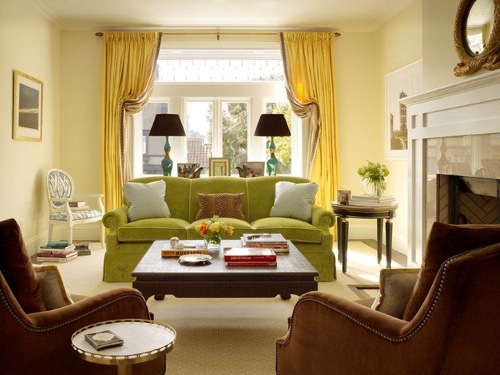

The living room sofa is upholstered in punchy green linen velvet. The glazed raffia coffee table is the Harrison Van-Horn ‘East West.’
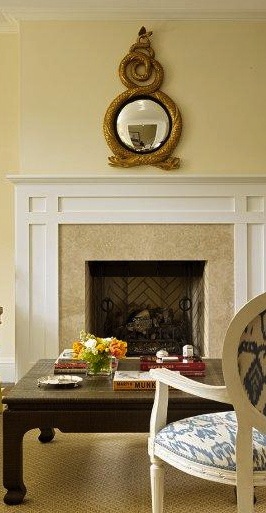
The statement piece over the mantel is Carvers’ Guild ‘Entwined Dolphins Mirror’ in hand-laid gold leaf. Weiss says, “I like that it wasn’t the usual star burst design.” She always goes with convex when it hangs high enough to cut off people’s heads since it’s “bad feng shui.” The ikat-covered Oly Studio ‘Sophie’ armchair adds a bit of global patterning.
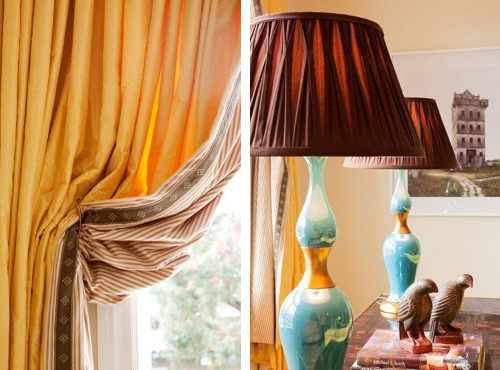
Initially the homeowner thought that silk curtains might be “too grown up,” but loved the idea once Weiss dressed them down with a cotton ticking lining. A pair of vintage lamps mirror the symmetry of the maize-colored silk drapes.

Weiss topped the pair of curvy turquoise lamps, purchased from Flessas Antiques in New York City, with custom brown silk lampshades.

D I N I N G R O O M

The dining room ceiling is based on the homeowner’s Meissen ‘Ming Dragon’ china. Following a base coat, a decorative painter used 15 coats of glaze. Weiss says, “You can literally see yourself in it.”

The wall color, a custom pale blue, was pulled from the sky of their Massimo Vitali beach photograph. (The couple has a number of fine modern photographs; the husband’s mother is a board member of the San Francisco Museum of Modern Art.)

The dining table is vintage 1950s Paul McCobb and the chairs, which are covered in dark blue mohair on the front and stamped lizard on the back, are Baker ‘St. Germain’ chairs from the Thomas Pheasant Collection. They experimented with a number of fancy Murano chandeliers, but finally settled on a simple and inexpensive brass one from Circa Lighting.
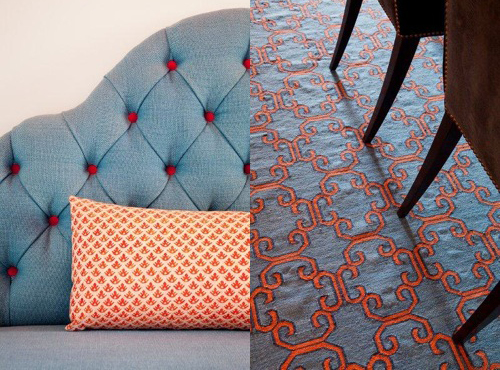
Weiss designed curvy banquettes to flank the entryway of the dining room. They’re on wheels to make it easy to roll one up to the table for extra seating. The Indian rug in the dining room is Irving and Fine through the Todd Alexander Romano showroom.

K I T C H E N
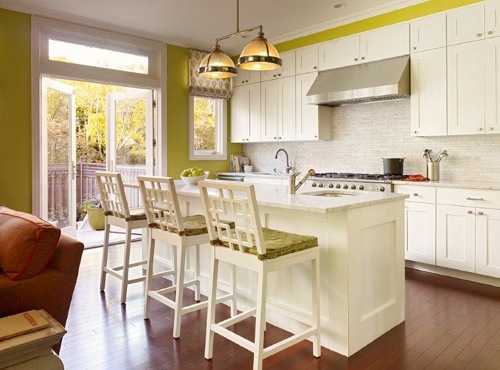
Mixing high and low, Weiss upholstered West Elm bar stools with Muriel Brandolini ‘Chartreuse 2’ that she had laminated for easy clean up. The acid green wall color is Fine Paints of Europe #S2040-G80Y, which continues into the family room, below.

F A M I L Y R O O M
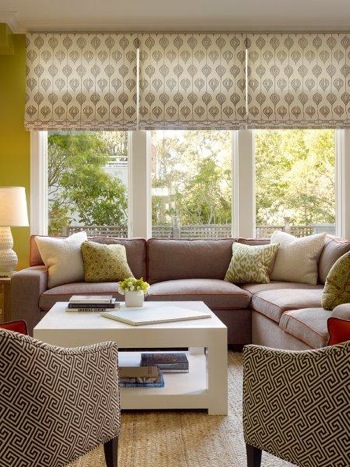
The neutral colored sofa is piped in coral, a color that references the ceiling of the adjoining dining room. The chairs are upholstered in Schumacher ‘Saint Tropez’ in ‘Java,’ a durable outdoor fabric.

H A L L
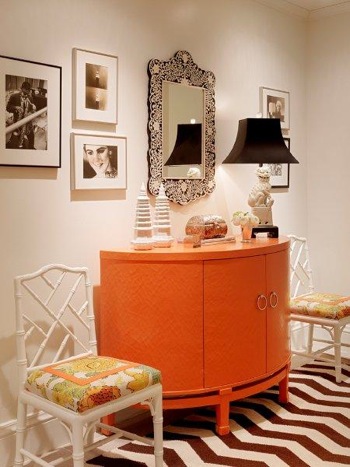
A persimmon demi-lune chest in the mudroom is flanked by Jonathan Adler ‘Chippendale’ side chairs in white lacquer, upholstered with a Palm Beach, ’70s style floral. The rug is from West Elm ‘Zig Zag.’

M E D I A R O O M
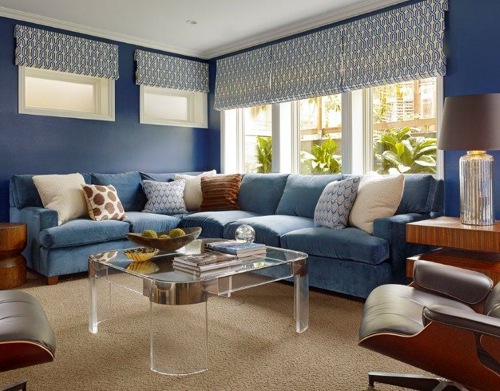
The denim-colored tone-on-tone media room is where the husband hangs out. Weiss worked with him to outfit it with comfortable and durable furnishings. The overstuffed sofas are upholstered in Schumacher ‘Cotton Club Velvet’ in ‘Midnight Blue.’

The Lucite and chrome table, which Weiss sourced on 1st Dibs, was a bit of a hard sell, but the rounded corners (safe for kids!) helped convince him. The shades are China Seas “Gorrival Fretwork’ in ‘French Blue.’

P O W D E R R O O M
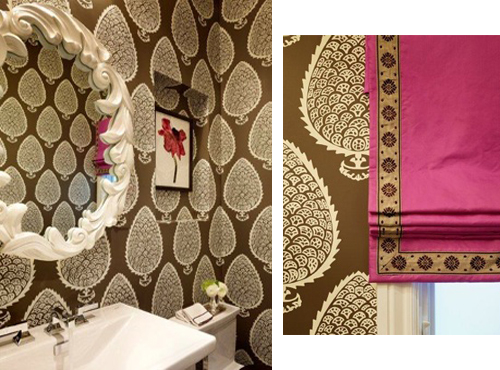
The powder room is papered in large-scale Katie Ridder ‘Leaf’ wallpaper in cream and chocolate. The ivory mirror is World’s Away ‘Rococo.’

The Roman shade is Cowtan & Tout ‘Tiffany’ silk in mauve with a Samuel & Sons trim.

M A S T E R B E D R O O M
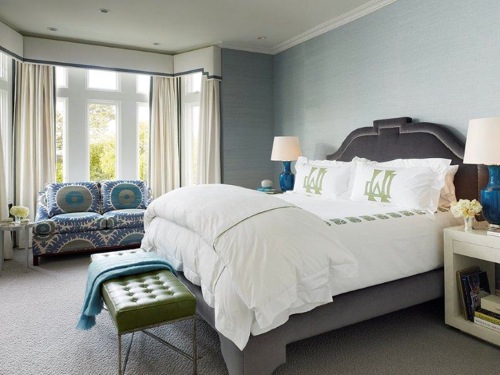
The bed in the master suite is made in luxuious white Leontine linens monogrammed in apple green, picking up on the color of the tufted Oly Studio ‘Jonathan’ bench upholstered in Holly Hunt ‘Stingray’ leather in ‘Irish Sea.’ Weiss designed the headboard, upholstered in blue mohair with nail head detailing. The loveseat is covered with Donghia ‘Suzani’ in ‘Blue Bliss.” Christopher Spitzmiller porcelain lamps top the bedside tables.
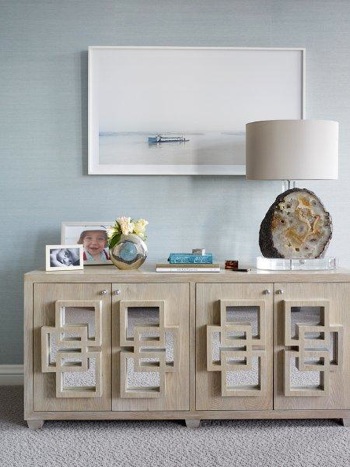
In the master bedroom, a photograph from Sze Tsung Leong’s ‘Yangtze River’ hangs above the World’s Away Crosby entertainment console, a limed oak cabinet with geometric, mirrored detail. The walls are covered in pale blue grass cloth. The blue agate lamp is from Belvedere Antiques in New York City.
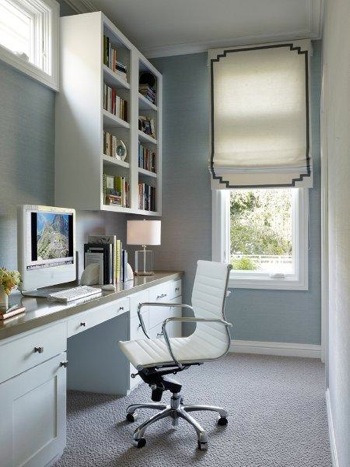
The adjoining study boasts custom cabinetry and an Eames Management Chair in white leather. The neutral Roman shade is edged in tealtape, notched at the corners, and the silver carpet is from Stark.
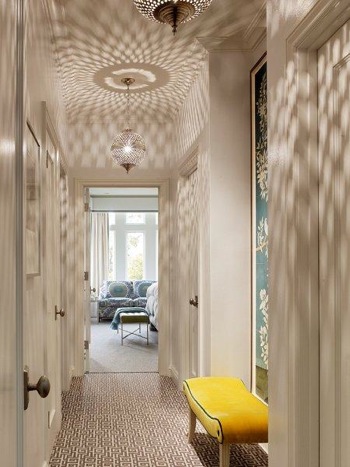
For the dressing room hallway of the master suite, Weiss wanted, “Just a little moment there.” They went with inexpensive lanterns from a Moroccan import place that cast lacy shadows on the walls and ceiling. A Hickory Chair bench upholstered in a deep yellow and edged with teal sits in front of a niche hung with a framed section of hand-painted wallpaper.

N U R S E R Y
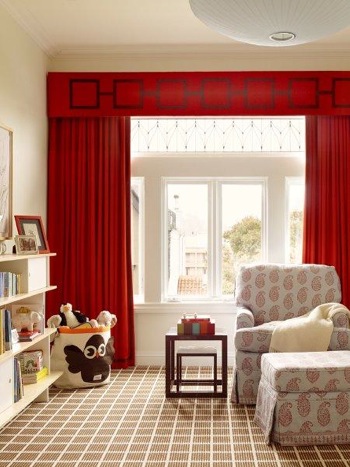
The nursery won’t need de-babyfying. Formal red drapes and valance are sophisticated but not to. An existing armchair and ottoman was redonein Peter Dunham ‘Kashmir Paisley’ linen. The checked wall-to-wall carpet works well for kids—it’s soft and stain-resistant.
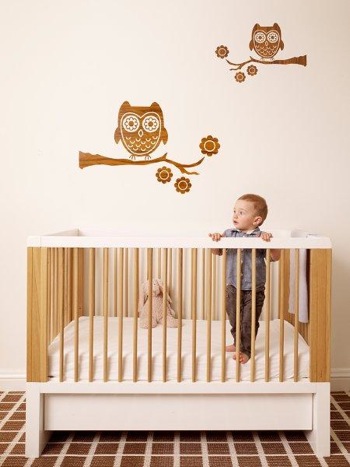
Weiss chose ‘Wood Owl’ wall decals from Etsy rather than artwork in case of an earthquake. The crib is the ‘Cabine’ by Netto Collection.

G U E S T R O O M

The guest room was pulled together on a budget. Weiss swapped the chrome hardware on the bedside tables with gold and re-purposed an old headboard in inexpensive orange velvet. The toile slipper chair is a nod to the wife’s preppy East Coast roots. The draperies are Kravet ‘Pelago’ in ‘Haze.’

Palmer Weiss

Interior photography by Matthew Millman 
1 Comment

Filed under . REGULAR FEATURES, Design Diary, Rooms

Design Diary: Moroccon-Inspired Patio

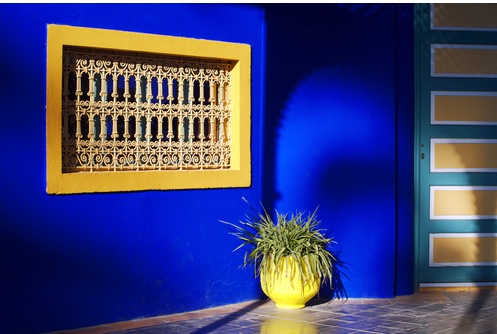
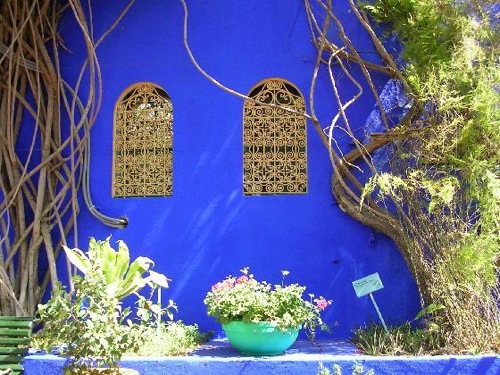
Today I had planned a post on the  Traditional Home digital issue of TRADhome, which launched on Friday. However, I don’t have the photos I need since my laptop is in the shop. So I dug into the archives of my old machine. This is based on a piece I wrote for Boston Globe Magazine, “Kind of Blue.” It’s about how a tiny patio in Boston, was transformed with the help of Brian Feehan, a director and choreographer, from a blah backyard into an entertaining oasis, inspired by Majorelle Garden* in Morocco, which the homeowner had recently visited.

* Majorelle Garden was designed by the painter Jacques Majorelle in 1924 and revived by fashion designer Yves Saint-Laurent and his partner, Pierre Berge, in 1980.

I N S P I R A T I O N

When Feehan first learned he was to create the hot garden splendor of Majorelle from an old brick patio in Boston, his first thought was, “Where the heck am I going to fit a 20-foot reflecting pool?”

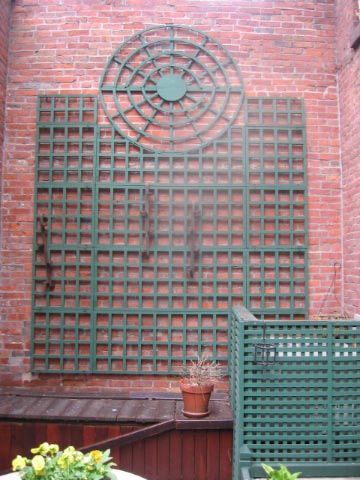
B E F O R E

Feehan managed to incorporate similar architectural elements, as well as a water feature. The first order of business was to paint the preppy green lattice with flat black paint, so it would recede. (They didn’t want to remove it since it hides the air conditioner condenser.)

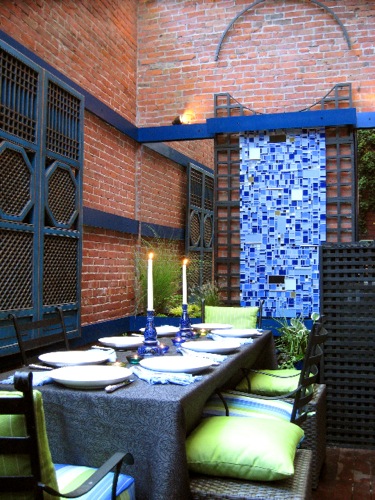
A F T E R

The gorgeous cobalt blue glass mosaic tile panel is actually an 8-foot-tall fountain. Water runs down the surface in uneven rivulets (the tiles are different thicknesses), and lights shine upwards to make it glisten. Look carefully—mirror panels are installed on either side of the trellis on which the fountain is mounted.

Feehan hung three horizontal strips of wood painted a deep cobalt blue around the perimeter of the space. They add color and emphasize the length of the patio. Also, the homeowner hangs votives and flower pots from them. Antique Chinese doors echo the lacy Moroccan scrollwork found at Majorelle.

The long table is great for dinner parties, but when she’s not entertaining, the homeowner can easily remove and store the top to reveal a much smaller, round table. The ottomans serve as extra seating during parties, and side tables otherwise.

Other than the fountain, the fixes aren’t extravagant or over-involved. That just may be more inspiring than Marrakesh.

Leave a comment

Filed under . REGULAR FEATURES, Design Diary, Flowers & Gardens, Food & Entertaining

Design Diary: Ladder District Loft by Duncan Hughes

I thought I new most of the designers in Boston, until I encountered Duncan Hughes. Talented, inventive, and sensitive to clients’ lifestyles and tastes, I met Hughes when I was assigned to write a story about a young couple’s downtown Boston loft for Boston Home’s Spring 2012 issue. Hughes’ work, as you can see here, is fresh and functional, with a sense of humor, a bit of drama, and more than a touch of the practical. (Unrelated tidbit: Hughes recently re-designed a home for Katherine Heigl in L.A.)

Photography by Eric Roth

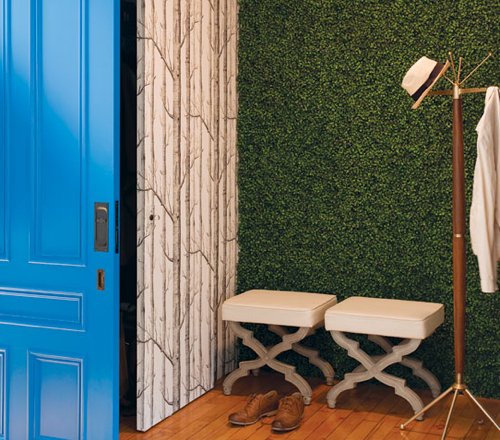
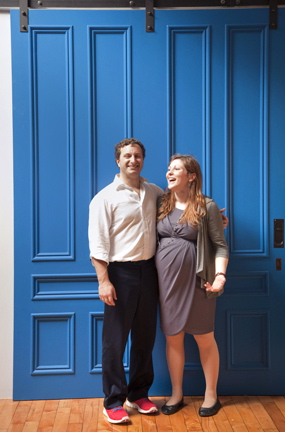
A wall of faux boxwood greets visitors when they step off the elevator. It’s a surprise of the after being on the busy city street. The ceiling is painted black to suggest a night sky. The sliding barn-style doors are mahogany doors salvaged from a school in Milton, Mass., painted electric blue. The contractor wasn’t thrilled about painting the beautiful old wood, but Hughes convinced him. Hardware: Barndoorhardware.com; wallpaper: Cole & Sons; stools: Wisteria; coat stand: Abodeon, Cambridge.

The elevator doors are done in chalkboard paint; great for last minute grocery reminders. Hughes helped the couple organize the huge living room space. The homeowner told me, “I never lived anymore where we could fit more than one couch, and it was obvious where it would go. Here, not only is there 20 places to put a couch, you could have more than one!”

Roman shades: Kelly Wearstler ‘Trellis’ for Schumacher; artwork: Yes.Oui.Si, Boston; credenza: Abodeon; gray sofa: Room & Board; brown sofa: The Bright Group, upholstered in leather with mohair seat cushion.
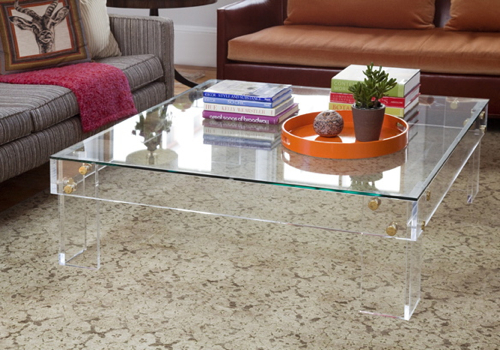
Hughes custom designed the cocktail table, fabricated in Lucite by Altec Plastics in Boston. (Yes, the rug is different in this photo, which I took when I visited for the walk-through and interview.)

Next to the living room is another seating area, inspired by Hughes’ recent African safari. He says, “I was fresh off a safari in Botswana, where we’d gather around a fire with director chairs and a full bar. I wanted that effect here. I didn’t want any matching chairs; I wanted it to feel like people just grabbed what was there and pulled them up to talk.”
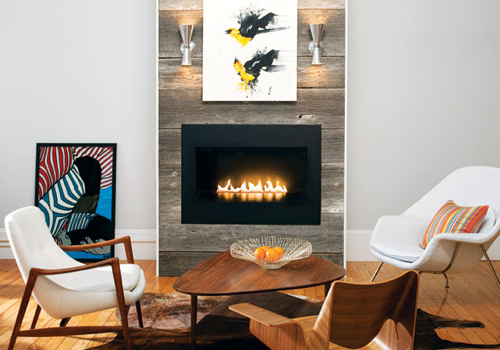
The trick to a mix and match chair ensemble? “Getting seat heights about the same height, so nobody feels out of place, and making sure everyone’s feet are on the carpet, even just one foot, so they feel like they’re in the group. “Coffee table and chair on left: vintage 1950s  from Reside, Boston; Womb chair from Addo Novo, Boston; wood chair by Blu Dot; artwork: Yes.Oui.Si, Boston.

The fireplace is gas from Sparks, with no hearth, for maximum simplicity. Hughes says, ” The theme is rustic meets modern with a little industrial sprinkled on top.” The surround is done in salvaged barn wood from Maine. Hughes started out wanting to line it with old railroad ties, for a log cabin feel, but ran into issues with toxicity. He chose each piece of wood very carefully, some with knots, some with old paint, and planned out exactly which sections of each board he would use. Later, the contractor picked them up and promptly sawed them right in half so they’d fit, nearly causing Hughes a heart attack. “I thought he was kidding, but we made it work.”

The sconces on the surround are vintage chrome pieces.

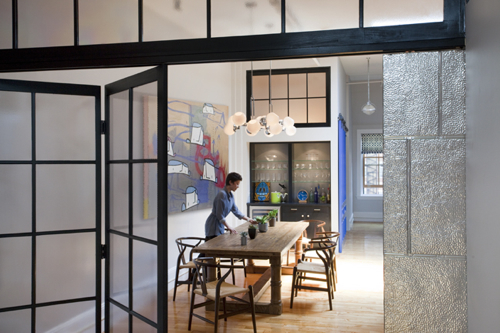
Hughes designed a faux window above the bar. It’s lit with fluorescent strips enhanced with gels purchased at a local performing arts hardware store, to get just the right quality of light that it resembles a window. The vintage chandelier has a bit of a deco feel. The long trestle table was handmade in California by the guy who originally had designed a similar table for Restoration Hardware.

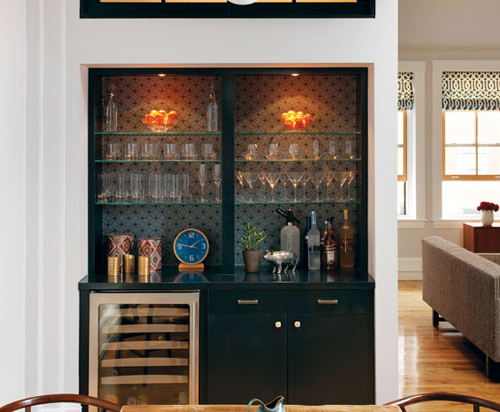
Hughes built in a bar on the back of the entry wall, borrowing space from an oversize coat closet. The couple likes to entertain, so the bar was high on their priority list.

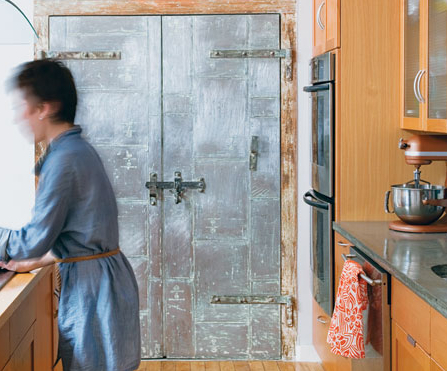
The kitchen was already intact when Hughes was hired, but he did spruce up the old fire doors, and added shelves behind them, creating a shallow space perfect for spice jar storage.

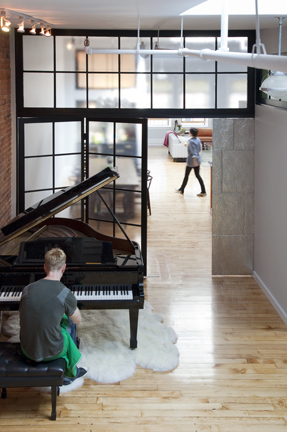
To separate the public and private spaces, Hugh designed the black room divider, fabricated from etched polycarbonate. The cloudy finish allows light through, but obscures the mess of toys and such behind it. The shiny tin panel on the right is a pocket door. The piano sits on an oversize sheepskin rug (six pelts sewn together) from Bowron Sheepskin in New Zealand.

Hughes designed an ingenious reading nook at the foot of the stairs, modeled on the outdoor lawn chairs of his youth. The adjustable back is woven with seat belt fabric. The cushion lifts up for storage. The bookcase is extra deep, and accessible from both sides.

Homeowners Darren and Colette Powell.

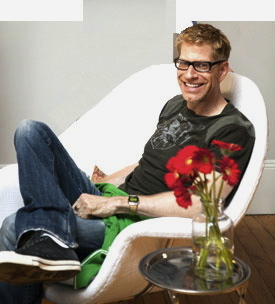
Designer Duncan Hughes.

For more about the space, design process, Hughes, and the homeowners, read the full story, “Unpolished Perfection” in Boston Home.

Leave a comment

Filed under . REGULAR FEATURES, Design Diary, Rooms

Design Diary: Jewelry Designer Nicole Rueda-Watts’ Live/Work Loft

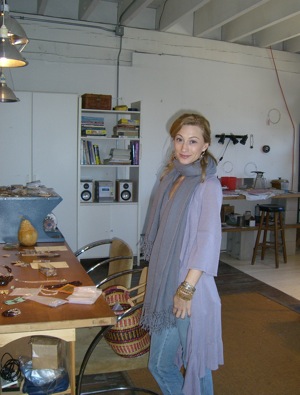
Back in 2009 I profiled jewelry designer Nicole Rueda-Watts and her loft for Stuff Magazine. Almost three years later, Nicole has since moved to a new studio space (written about this past fall by the ever excellent Tina Sutton for Boston Globe Magazine), but I think you’ll still enjoy the original photos I shot when I visited.

Nicole designs under the label Nyx Studio. Nicole, along with her mom Pamela Watts, run Reside, one of the best mid-century modern furniture shops in the area, with outposts in Boston and Cambridge.

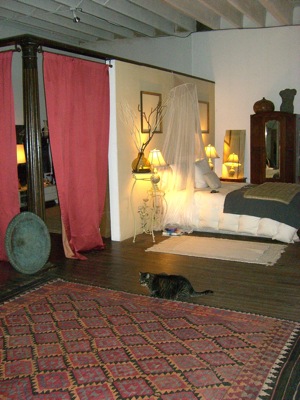
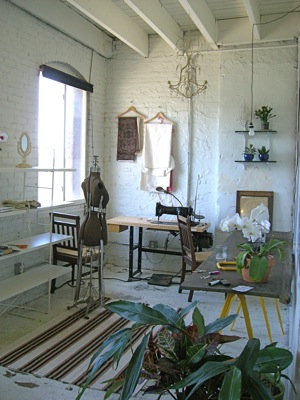
The view upon entering. The red-curtained area on the left is the walk-in closet/boudoir. When she first moved in she says, “There was debris everywhere, and weird makeshift tables bolted to the walls. But. . . this place was such a canvas.”

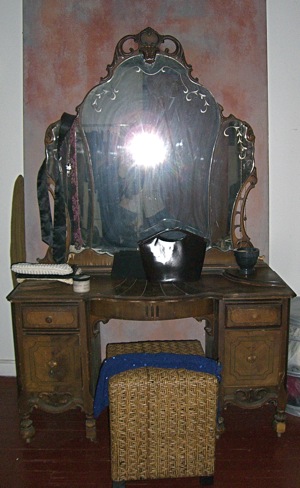
Vanity in the closet.

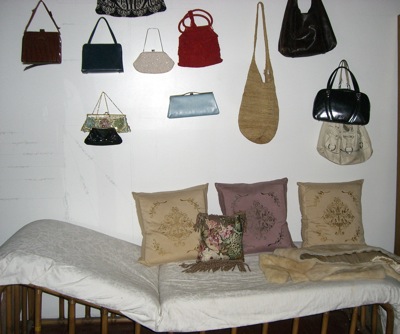
Bags above a daybed in the closet.

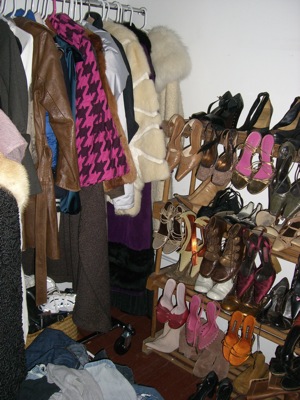
Plenty to wear.

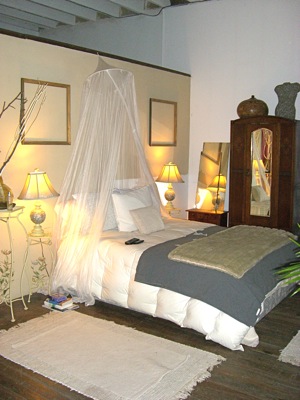
Mosquito netting keeps the bed area cozy in the wide open space. She found the bedside tables and lamps at Marshalls.

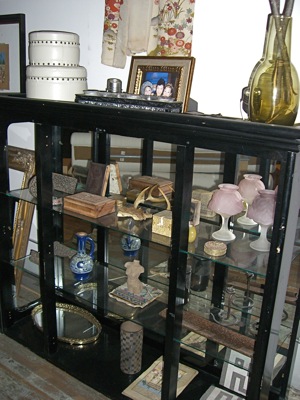
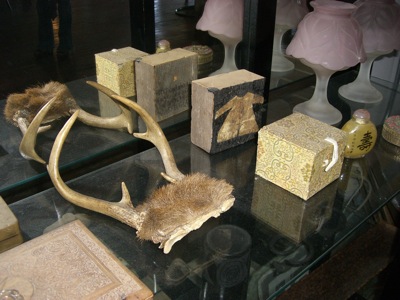
Display cabinet was a find in the garbage in Cambridge.

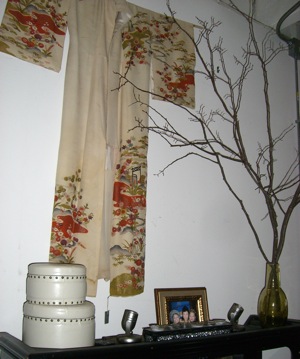
A kimono from her mom hangs above the cabinet. The tree branches came from a walk in the woods in Ipswich, Mass.

Antlers (with fur still attached!) on a shelf inside.

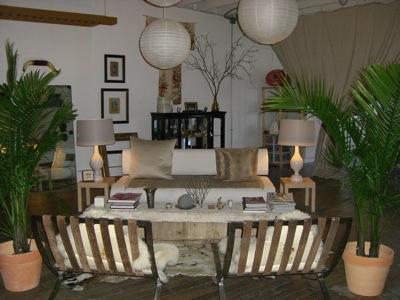
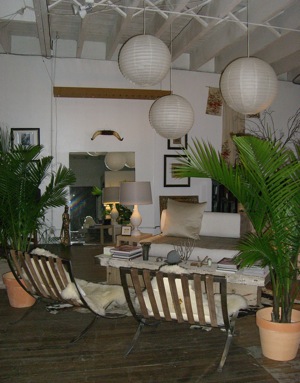
An overview of the living area. The pair of chairs are Barcelona lounges without the cushions. She got them from two guys who rescued them from a couple who left them behind when they moved to California. Lamps next to the sofa were $3 each at Goodwill.

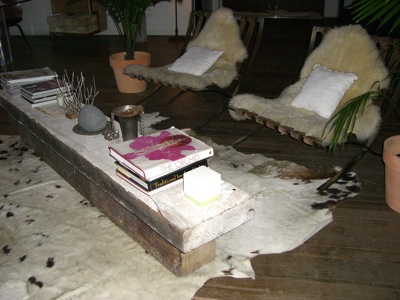
A closeup of the sheepskin draped Barcelona lounges. (Sheepskins from her mom, who got them at Costco.) The coffee table are just pieces of timber she found in an empty unit in the building.

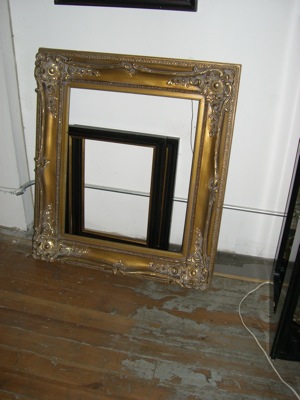
More finds left behind by building tenants.

The horns above the mirror were left in the basement of her mother’s house. Nicole sanded them down before hanging since they were yellowed.

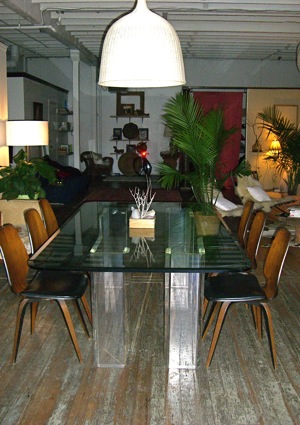
The glass dining table was here when she moved in, left behind by the photographer who occupied it before her, who came from a wealthy family. She says, “I have this vision that her elegant, totally ’70s parents with blue eye shadow and shag carpeting gave her this, but she never really liked it. It takes someone looking at it from a totally different angle to appreciate it.” The chairs are Plycraft, from her mom. The pendant is wicker from IKEA.

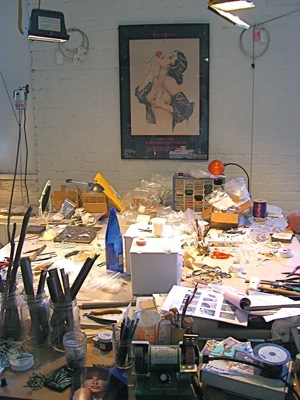
The studio is just beyond the living room, and can be closed off with an old burlap curtain she hung. This is the work table at which she makes all her jewelry.

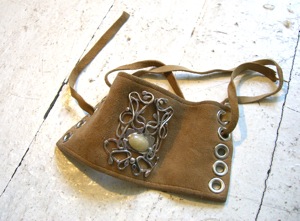
A suede corset cuff with silver-work and cabachon stone, from Nyx Studio.

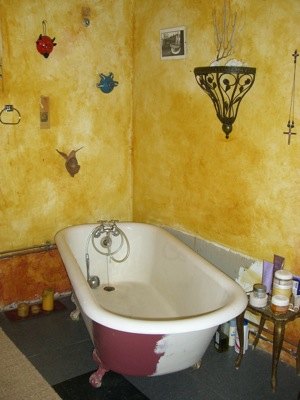
When she moved in , there was no shower or tub. Nicole and her brother found this tub in another unit in the building, dragged it over, and hooked it up.

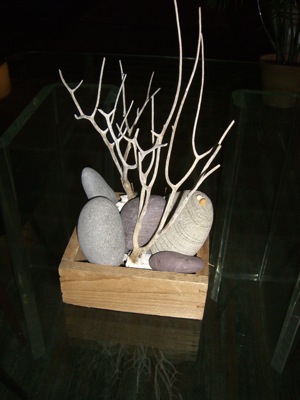
A sculpture she fashioned. The centerpiece is a piece of coral with branches growing out of it that she found and carried back from Mexico.

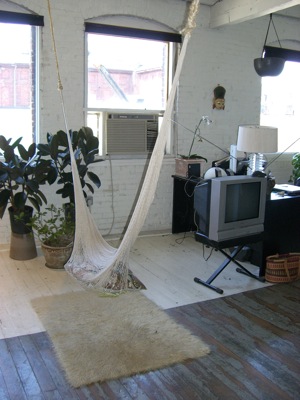
“Growing up our house was artsy. We had hammock on our porch, so I knew I needed a hammock. It’s funny that where my mom sits when she visits.”

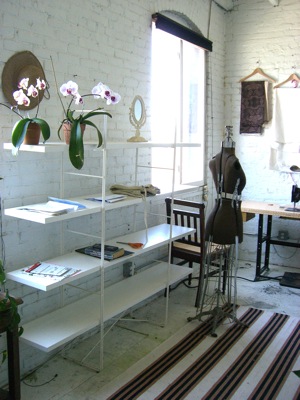
Nicole uses the little room off to the side as a sewing room. The chandelier is from a yard sale on the Vineyard.

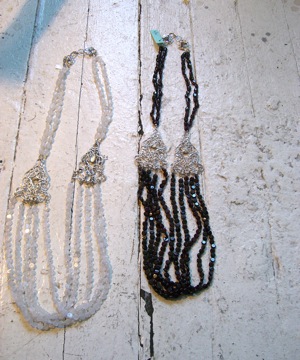
Nicole’s jewelry. She apprenticed with a silversmith in Mexico.

1 Comment

Filed under . REGULAR FEATURES, Design Diary, Fashion, Rooms

Design Diary: Bone Sculptures by Celia Nkala of Perception Park

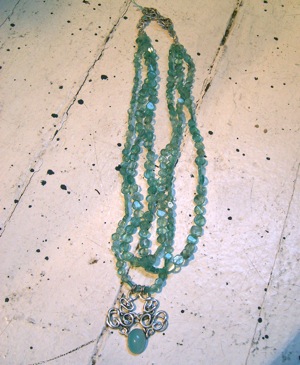
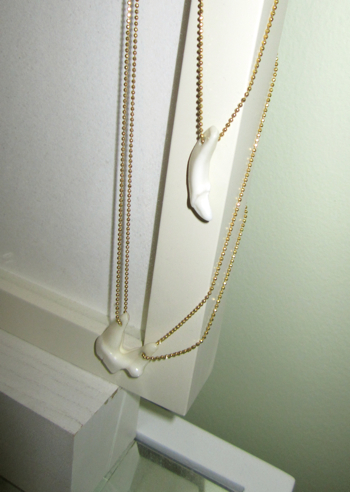
I first learned about Parisian-based sculptor/designer Celia Nkala’s line from Perception Park from a post I wrote for Design Milk. Instantly smitten (with her work and her… she’s so pretty), I struck up an email correspondence. She told me a bit about what prompted her to sculpt and work with bones and even sent me a two necklaces (made out of dog teeth!) to see how they’d play in the American market. Last week, she emailed me with photos of new creations, this time around, done in black.

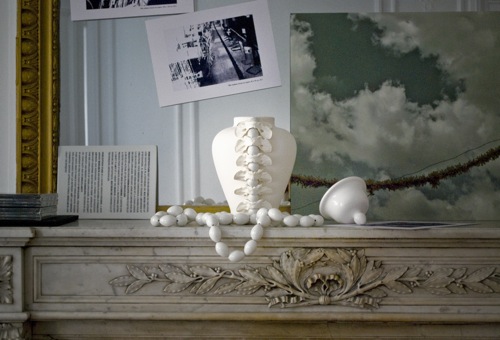
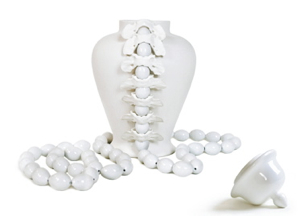
Vertebrae Vase

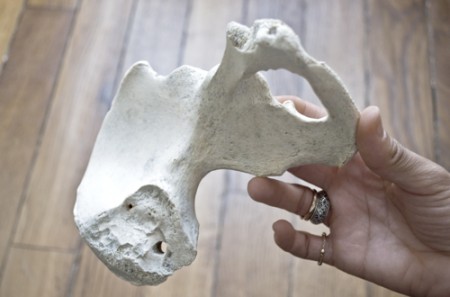
The Ossements collection was inspired by a real human hip bone that Celia found in a flea market in Brussels about a year-and-a-half ago. She says, “I was fascinated while the others were disgusted.”

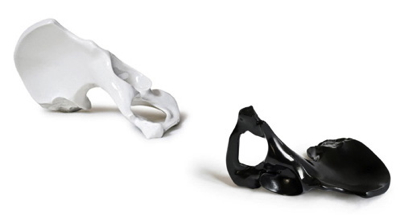
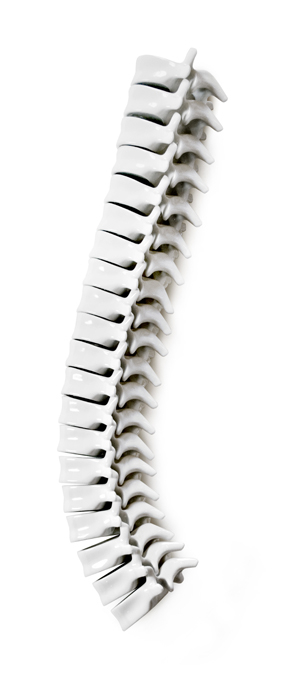
To make it more “acceptable,” she sculpted the shape in porcelain. The Iliac bone was the first sculpture she had ever created. She borrowed a human skeleton from the anatomy department of a medical university to use as a model for the other pieces, which include vertebrae and sacrum.

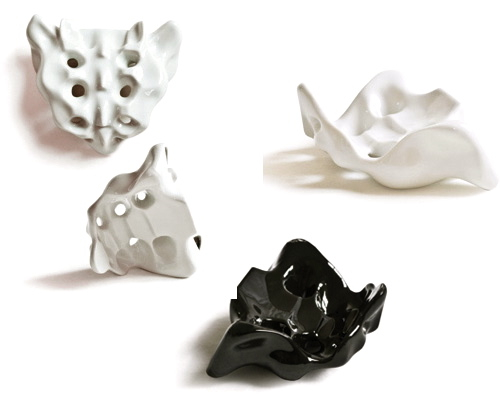
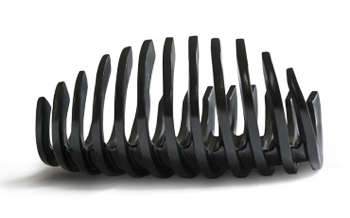
She recently introduced shiny black versions of several of the works. Here is a sampling:


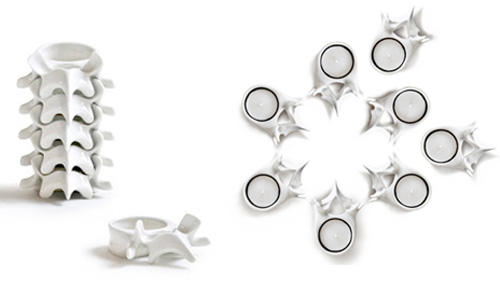
Vertebrae Votives

Iliac Bones in Enameled Porcelain

Sacrum in Enameled Porcelain

Rib Cage Sculpture in Enameled Porcelain

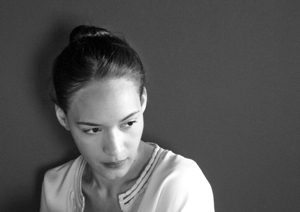
Celia is holding a real human hip she found in Belgium; the catalyst for the collection.
The horizontal bits on the vertebra vase are actual bones. Nkala found a stock of cow’s sphenoid bones (the cow’s last vertebra) by chance in a Chinese shop in Paris, and bought the entire stock. She says, “I discovered that earthenware biscuit is visually similar of the bone material, so I have associated them directly with ceramics.”
The annotated diagram above shows that the vertical section is a piece of enameled porcelain, and the horizontal vertebrae are real animal sphenoid bones.
 Celia sent me two dog tooth pendants. I wear them all the time, and show them off at every opportunity. Definitely a conversation starter.  A dentist mom at a potluck said she wasn’t sure they were definitely dog teeth, so I wore them to the vet when it was time for Oakley’s check up. (Oakley is my very sweet cat.) She confirmed, they’re definitely dog teeth. (Not that I doubted you Celia!)  Do you guys like them? They’re not available commercially yet, and I know Celia would appreciate any input.

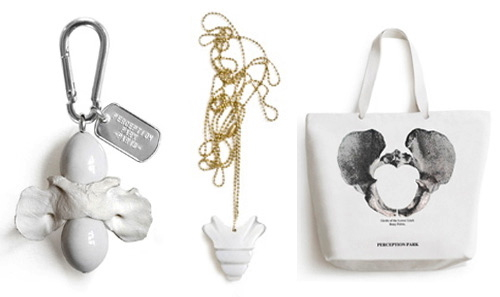
Animal Sphenoid Bone Keychain   |   Coccyx Pendant   |   Bony Pelvis Tote
Vertebrae votives all stacked up.

Leave a comment

Filed under . REGULAR FEATURES, Design Diary, Fashion, Home Accessories